



Carl Jung, the psychologist of the first half of the 20th Century, was one of the first to acknowledge and investigate the unconscious and was prolific in his work with archetypes.Carl Gustav Jung (1875–1961) was a Swiss psychiatrist who became one of the founders of depth psychology and was particularly fascinated by the unconscious mind, of which with his own, he was deeply connected to, inspired and disturbed by. As a result, he became increasingly interested in dreams, mythology and religion, all of which are very much composed of archetypes.
The word archetype comes from the Ancient Greek arkhetypon, meaning “first-molded” or “original pattern”. Archetypes are universal patterns or concepts underlying deep recurring human experiences. They can be character archetypes such as The Hero, The Seer, The Villain, The Trickster, The Innocent, The Mother, or they can be situational such as The Quest, The Loss, The Victory.
In all the work done to investigate the unconscious mind, it is abundantly clear that this is where repressed memories and feelings reside and where our wellspring of intuition and wisdom is.
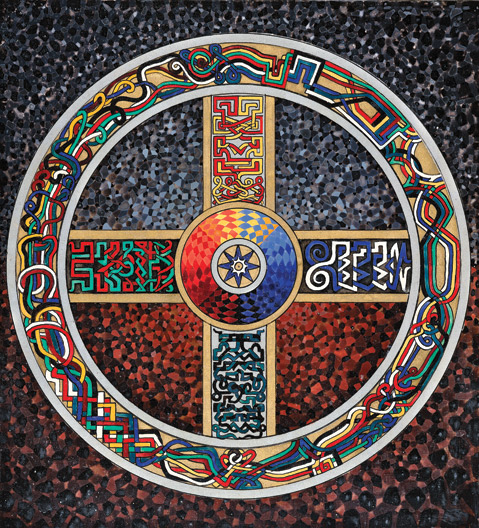
Jung saw the unconscious as communicating through archetypes and several archetypal figures became central to his work. He recorded all his own communication with his own unconscious and archetypes in a “Red Book”, two pages of which you can see at the top of this page. The most recurrent archetype he saw, and which he regarded as his “Spirit Guide” was the character Philemon from the Ancient Greek myth.
Both of us have read extensively about Jung and studied pages from The Red Book. His experiences and ideas have helped us to develop a deeper understanding of the archetypal images found throughout the Rider–Waite–Smith Tarot deck. We approach these images from many perspectives, exploring not only their traditional meanings but also the psychological forces, inner conflicts and possibilities they may awaken within us.
Jung believed that psychological wholeness is found through individuation: the lifelong process of bringing the conscious and unconscious aspects of ourselves into a more harmonious relationship.
This requires us to look inward and encounter both the light and the darkness within us: the light of intuition, creativity and wisdom, alongside the darkness of fear, repression and unresolved trauma. The aim is not to destroy or deny any part of ourselves, but to recognise it, understand it and find its proper place within the whole.
Through this process of self-understanding, we may begin to reconcile the hidden contents of the unconscious with the awareness of the waking mind. This is how we can move forward with greater harmony, no longer governed by unseen patterns.
It is through self understanding, delving deeply into our unconscious and reconciling both the light of wisdom and the dark of trauma within it with our conscious waking mind. It is this way that we will find harmony and our true core self so we can go forward the most authentic and enlightened version of ourselves.
Leave a Reply