


Part 1 of 3: The I, II and III of Wands

My sister and I have re-examined the Wands suit this week and will be examining the other suits in forthcoming weeks.
It is widely accepted that the suit of the wands represents the element of fire. If you look at the human being through a fourfold lens of mind, body, emotions and soul then the suit of the wands is the soul from which comes our creativity (divine inspiration) and individuality.
We had started out with the idea of looking at each number in turn, i.e. looking at all the fours of a suit and on looking at the four of wands we pondered at the idea of the person in III looking back at the castle from II from which the descent has been made and we realised that we wanted to look at all the wands in order.
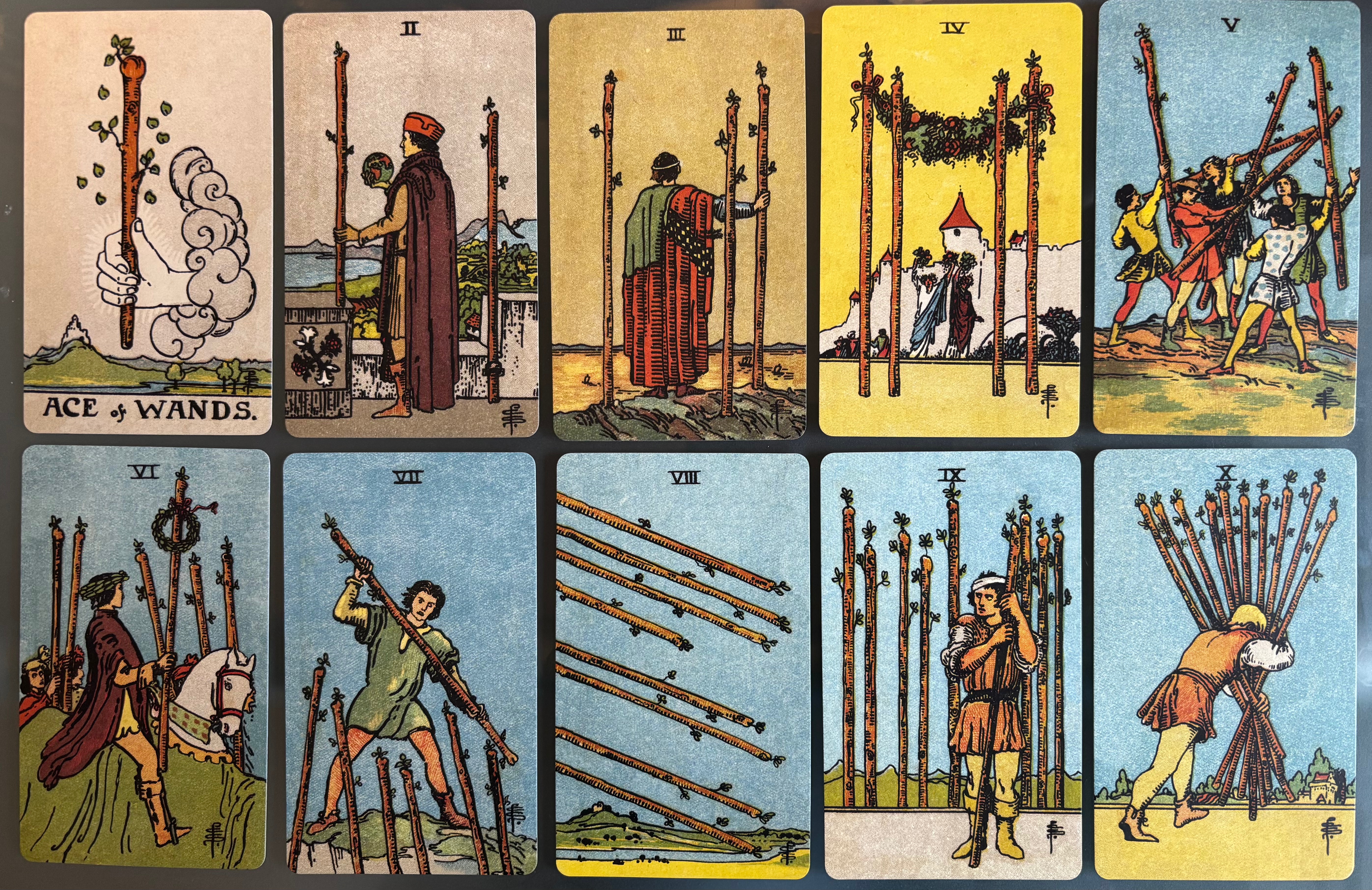
So we begin our journey with the hopeful Ace of Wands, appearing from a magical cloud, inspiration from another realm with a white castle on a hill in the background. There is something very pure and innocent about this card, the predominant white, the curly cloud and the fairytale reminiscent castle. The only question we still have is the significance of the 8 airborne leaves, but will will revisit that in the future.
In the II of Wands, a person appears at the beginning of their journey. The II of Wands is probably the card that invoked the most discussion as this card is very heavy in its symbolism. The man stands on stark grey battlements with two expressions of duality. Firstly, the staff held in his left hand, whilst the second is bound to the battlement at his right. Secondly is the globe in his right hand and the lily rose cross pennant pinned to the battlements at his left.
If we look at this in terms of the functions of the right and left brain hemisphere, then the right hand side is about the conscious and the real and logical, whereas left hand side is about creativity, symbolism and metaphor. In this context, in the right hand we have a map in the form of a globe to guide the holder in the physical world whilst the wand of creativity and spirit is bound. In the left hand we have the wand (creative energy) held firmly in the human hand and the pennant pinned to the wall is a spiritual map in the form of the lily and the rose on the black cross. This small image is extremely significant.
Esotericism was quite interconnected in England at the turn of the 20th Century. Pamela Colman Smith (the illustrator of the cards) and A. E. Waite were both members of the Hermetic Order of the Golden Dawn which had some connections with the Theosophical Society which Rudolf Steiner was also connected with. All these make mention of the significance of the Rose on the Cross (from Rosicrucianism) and Steiner particularly talks about the transmutation from the lily to the rose via the black cross. In short it is the idea of the spiritual journey of bringing the divine from within, through the barrier of the ego by transforming it on the “black cross” which is a symbol of the remains of the base elements from which the newly transformed soul grows, with both purified passion, energy and love.
In III, a man with a circlet (reminiscent of the Magician) is down on the edge of the water. He looks out at the ships on the sea at the Golden Dawn (the colours of the card) and holds a staff in his right hand with two behind him, “at his back”. This is another very hopeful card. There is opportunity ahead. You are expanding your horizons.
Leave a Reply